
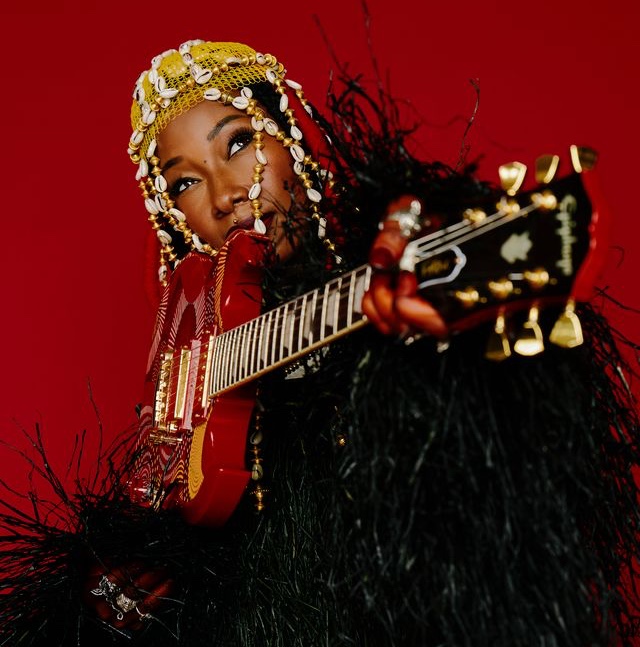
Fatoumata Diawara Is Spotify’s EQUAL Africa Artist for June 2026 — and She’s Just Getting Started
There are artists who make music, and then there are artists who change what music is allowed to be. Fatoumata Diawara belongs firmly in the second category. The Grammy-nominated Malian singer-songwriter, guitarist and actress has just been named Spotify’s EQUAL Africa artist for June 2026, a recognition that feels less like a milestone and more like the world finally catching up.
Who Is Fatoumata Diawara?
Born in Côte d’Ivoire and raised across West Africa, Fatoumata Diawara’s story is one of restless, purposeful motion. Her journey from Mali’s film and theatre space to music exemplifies her evolution as an artist. She began as a backing vocalist for the legendary Oumou Sangaré — one of the most important women in African music history. That apprenticeship clearly shaped her. Diawara carries the same moral seriousness, the same refusal to separate art from social reality.
Her debut album, Fatou (2011), introduced her to the world and set the stage for notable collaborations. Since then, she has worked with:
- Damon Albarn, Gorillaz
- Disclosure
- Herbie Hancock
- Paul McCartney
- The Lamomali collective, which drew 450,000 spectators in France in 2025
She has been nominated for a Victoires de la Musique and has built a reputation as one of the most compelling live performers working in any genre today.

MASSA: Her Most Personal Album Yet
Released on 5 June 2026, MASSA (meaning “The Eternal” in Bambara) is Fatoumata’s most introspective work to date. Co-produced with French pop icon and guitar hero -M- (Mathieu Cheddid), the 12-track album explores motherhood, faith, memory, grief and resilience, including a tribute to her late father, whose love continues to guide her beyond his passing.
What makes MASSA remarkable is what it refuses to sacrifice. As music critics at Far Out Magazine observed, the album is a stark reminder of her all-encompassing mastery of songwriting and performance, positioning her among the greatest African artists of modern times. Critics at The Sun Never Sets On Music noted that Diawara and Cheddid use pentatonic scales and Mandinka rhythms to anchor heavy blues and rock inflexions, so traditional Malian instrumentation is never window dressing but a load-bearing structure.
The lead single “Sigui” is a perfect case study: hypnotic, driving grooves layered with blistering guitar lines, tackling the quiet corrosion of polygamous family dynamics. Another standout, “Denko,” sung in Bambara, delivers social critique on the isolating burdens faced by mothers of disabled children — quiet, devastating, and deeply necessary.
Making History With Gibson Epiphone
Beyond the album, 2026 has been a landmark year for Diawara in another arena entirely. In January, she became the first woman of colour to receive an Epiphone signature guitar. It’s the Fatoumata Diawara SG, an instrument designed from her passion for the Epiphone Muse SG, with Malian-inspired graphic artwork on the body, push/pull coil-splitting for genre-blending versatility, and gold hardware accents.
Guitar World confirmed it as gig-ready straight out of the box, high praise for a signature model in any price range. But the cultural significance goes beyond specs. As Diawara told Guitar World: “This guitar carries my Malian roots and my voice. As a Malian woman, receiving this signature guitar reminds me that our stories and our sounds truly belong on the world stage.”
The guitar is available now via Epiphone.com and Gibson Garages in Nashville and London.
What Spotify’s EQUAL Programme Means, and Why This Selection Matters
Spotify’s EQUAL Africa programme exists to spotlight women redefining the continent’s music narrative. Fatoumata’s selection is not honorary — it’s editorial. “Fatoumata’s music reflects the creativity and drive that have helped shape Africa’s current music scene,” says Phiona Okumu, Spotify’s Head of Music for Sub-Saharan Africa. “She represents how African women are advancing visibility, driving opportunities, and building global connections through their art.”
That’s a carefully chosen set of words. Visibility, opportunity, connection, these are structural outcomes, not just cultural ones. EQUAL matters because streaming data translates directly into tour booking leverage, sync licensing consideration, and label investment. When a platform with Spotify’s reach centres a Malian woman’s album in June 2026, the downstream effects for African women artists are real.
In Her Own Words: Fatoumata on Music, Womanhood and Power
Part of what makes Fatoumata Diawara such a compelling interview subject is that she does not traffic in safe answers. Asked about navigating a male-dominated industry, she offered something blunt and beautiful: “The day I picked up a guitar, I already felt equal. The guitar became my weapon, my freedom, and my voice.”
She traces her love of music to a moment of early grief, the loss of her sister when she was very young. “Instead of crying, I started singing. Music became a way for me to express emotions I couldn’t put into words. It was like turning rain into sunshine.” That framing, alchemy over pain runs through everything she makes.
Her musical influences include:
- Amadou and Mariam
- Fela Kuti
- Ali Farka Touré
- Kassav’
- Miriam Makeba
It’s a constellation of African artists who also spent careers insisting that local tradition and global ambition are not in conflict.

Q&A with Fatoumata Diawara
Q: Who is Fatoumata Diawara, and why is she significant?
Fatoumata Diawara is a Grammy-nominated Malian singer-songwriter, guitarist and actress whose music fuses Wassoulou and Mandinka traditions with blues, rock, folk and global pop. She is significant for her artistic longevity, her socially engaged songwriting, her role as a mentor and pioneer for African women in music, and — in 2026 — for becoming the first woman of colour to receive an Epiphone signature guitar.
Q: What is Spotify’s EQUAL Africa programme?
Spotify’s EQUAL Africa programme is an ongoing initiative designed to amplify the voices of women artists across the African continent. Each month, a featured artist is spotlighted across Spotify’s editorial platforms to increase streams, discovery and opportunity for women in African music.
Q: What is Fatoumata Diawara’s new album MASSA about?
MASSA (released 5 June 2026) is Fatoumata Diawara’s most personal album to date. Co-produced with -M- (Mathieu Cheddid), it explores motherhood, faith, memory, resilience and grief — including a tribute to her late father. The 12-track record blends Malian musical heritage with blues, rock and pop textures.
Q: What is the Fatoumata Diawara Epiphone SG?
The Fatoumata Diawara Epiphone SG is a signature electric guitar launched in January 2026, making Diawara the first woman of colour to receive an Epiphone signature model. The guitar features Malian-inspired artwork, Alnico Classic Pro humbuckers, push/pull coil-splitting and gold hardware. It is available via Epiphone.com and Gibson Garages.
Q: What African artists did Fatoumata Diawara grow up listening to?
Fatoumata Diawara has cited Amadou and Mariam, Fela Kuti, Ali Farka Touré, Kassav’ and Miriam Makeba as formative influences. These artists shaped her understanding of how African music can be simultaneously rooted in tradition and globally resonant.
Fatoumata Diawara’s selection as Spotify’s EQUAL Africa artist for June 2026 is more than a playlist feature, it’s a marker of where African music is, and who is driving it forward. With MASSA now out in the world and a landmark Epiphone guitar carrying her name, she is having one of the most consequential years of a career already built on landmark moments. Stream MASSA on Spotify now, and if you want to understand where contemporary African music is heading, start right here.


No Comments