
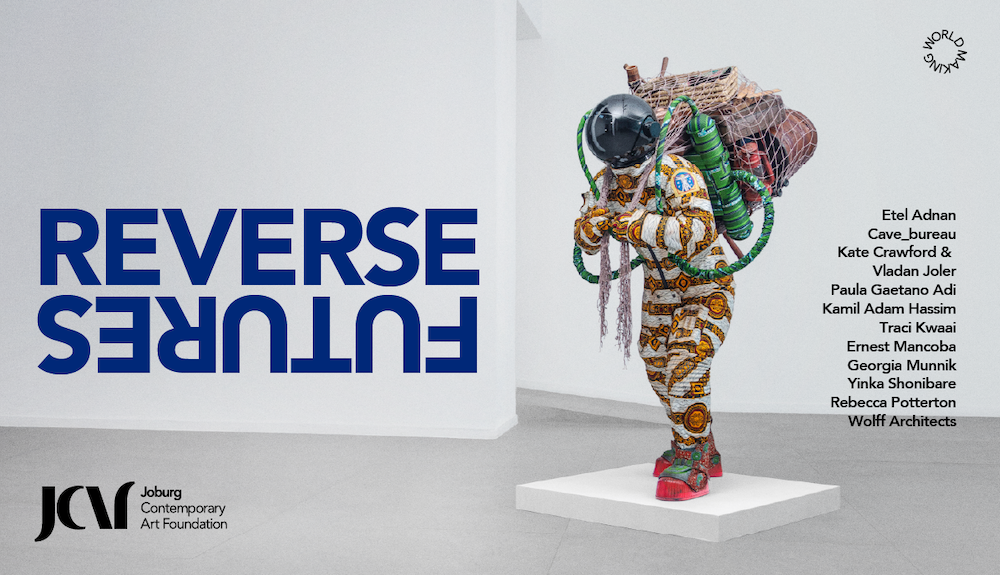
JCAF Reverse Futures Exhibition Explores Time, Space and Alternative Futures
Inside JCAF Reverse Futures Exhibition
Special Projects
There is a room in the Joburg Contemporary Art Foundation (JCAF) designed with a real, living sense of architecture in mind. It is a space designed not to house art, but to create a community and spark social interaction and genuine connection.
The layout of the Reading Room, by Wolff Architects, is designed to naturally invite guests to gather in a circle formation, facing and engaging with one another. Built with the purpose of uniting people, it was commissioned specifically for people to sit in, and have a chat about what the exhibition you have just moved through.
This is not your typical white cube gallery experience where you enter, stare silently at a wall, and leave. It is an active, living hub where podcasts are recorded, workshops are run, and the community gathers. And it serves as the perfect entry point into the JCAF’s latest exhibition: a journey that collapses the boundaries of past, present, and future, inviting us to rethink our time, place, and space, in the universe.

Introduction
Calculating History and Empire
Moving from this communal space into the heart of the exhibition, we are immediately presented with a wall showing ways in which time and space interconnect.
The first major work, Calculating Empires: A Genealogy of Technology and Power since 1500, by Kate Crawford and Vladan Joler, is a staggering wall that maps the relationship between technology and power over the past 500 years. It allows you to physically trace the lineages of our modern-day systems all the way from the 1500s. You can see how early weaponry and communications have slowly evolved into missiles, and finally, into the quiet, terrifying reality of neurological AI warfare.
It is a striking piece of academic scholarship and graphic design that speaks directly to the show’s overarching conversation. It reminds us that technology is never neutral; it is an apparatus of power that has been continuously built upon for centuries.
Section 1: Space
The Displaced Astronaut and the Unpredictability of Travel
Standing opposite the visual manifesto about how empires have used technology to concentrate power over five centuries, is British-Nigerian artist Yinka Shonibare’s Refugee Astronaut X. On loan from Foundation H in Madagascar, the sculpture features a life-sized astronaut carrying a heavy load on their back. Not filled with high-tech space gear, but rather with personal artefacts like binoculars, photos, a drink, and pots and pans.
The astronaut wears a space suite covered in a beautiful bold African wax print, bright red shoes, and a glossy black helmet that completely hides the astronaut’s identity, and only reflects yours. Looking beautifully, painfully lost, the astronaut is in search for a new home after the earth has been spent.

Behind this monumental figure lies a very real, very human story of global logistics. Because of its size, the artwork couldn’t fit in a standard passenger plane. Shipping it from Madagascar, just across the water from Mozambique, turned into an epic, month-long saga. Amid global fuel shortages and geopolitical wobbles, the piece was loaded onto a boat that stopped in Mauritius, sailed down to Port Elizabeth, and had to be rescued by a truck that drove it up to Joburg just in time for the opening.
There is a beautiful irony here: an artwork about a displacement, traveling spacefarer itself underwent a fragile, unpredictable journey across oceans just to stand in the JCAF gallery space.

Stepping Into the Muon Stream
The exhibition shifts next to the cosmic and the unseen. South African artist Kamil Adam Hassim’s presents Event Horizon work is deeply informed by his time spent in residencies at CERN (the European Organisation for Nuclear Research) and his collaborations with astronomers at the South African Large Telescope (SALT). He is fascinated by indigenous wayfinding, the ancient Polynesian and African systems of navigating across vast, empty spaces using nothing but the stars, sun, and ocean swells.
To experience his installation, you must step into a sensory decompression chamber.
You walk through a flood of deep red light, then into total darkness, and finally into a mist-filled chamber where a device clicks every single time a cosmic muon particle strikes the space. It is an astonishingly embodied, spiritual experience. You are standing in the pitch black, feeling the invisible, radioactive rain of the universe pass right through your body, connecting you to the infinite expanse of outer space.
Section 2: Time
The Weaving of Time and the Primordial Cave
As you emerge from the darkness and turn a corner, you are met with works that explore mark-making as a universal language of abstraction. It’s the primal human impulse that connects us to the very first gestures left on cave walls.
Shimoni Slave Cave is brought to life by Cave_bureau, an architectural collective from Kenya that employs a methodology they call reverse futurisms. They look back into the deepest histories of human dwellings to understand how we can better navigate our present and step more consciously into the future.
“While the central idea of the Reverse Futures exhibition engages with technology, it does this from a local vantage, asking fundamentally humane questions about the world we inhabit.
How might we imagine a better world not built on power and extraction, but one that enables us to think about our future in South Africa as part of a continuum of community, environmental care and historical learning?
Can artists help us to define a new path for future generations that is generative and equitable? Through spectacular and subtle ideas, offering beauty and pathos, the exhibition will excite adults and children alike,” says JCAF’s Executive Director and curator of the exhibition, Clive Kellner.

The title Reverse Futures is derived from Nairobi-based architectural practice Cave_bureau who coined the term ‘reverse futurism’ to address the impact and effects of colonialism in Africa and specifically Kenya, explaining that “for the future to exist we need to undo the mistakes of the past” [Mohamed, B. (2025). “Design in Deep Time”, in Future Observatory Journal No. 3]. Reverse Futurism refers to remedial acts that address this history and the present at the same time, while making pathways of healing in the midst of colonial and ongoing neocolonial affective and administrative architectures [Karanja, K. & Mutegi, S. (2023). Cave Bureau, The Architect’s Studio. Humlebaek, DK: Louisiana Museum of Modern Art, pp. 52, 84, 105].
Their installation features a stunning, suspended 1:1 scale replica of a section of the Shimoni slave caves on the Kenyan coast. Using 3D computer mapping, they have recreated the undulating, organic structures of the cave using a laborious, repetitive Japanese bamboo weaving technique called paponi.
The Shimoni caves have a heavy, traumatizing history; they were used to hold slaves during the 19th-century East African slave trade before they were forced onto ships. By suspending this woven structure above us, Cave Bureau forces us to stand beneath the weight of this history. It is an act of profound beauty and memorialization, turning a site of historic trauma into a space of quiet contemplation, ancestral honouring, and architectural reimagining.

Section 3: Place
The Perfumed Streets of Jo’burg and the Gentle Robot
The exhibition does not stay trapped in the distant past or the far reaches of outer space. It lands right back in the concrete pavements of Joburg.
In one corner, The Strangling Fruit, by Georgia Munnik, fill the air with familier scents. A factory artist working with perfume has collaborated with glassmakers to capture the scent of the city. But this isn’t the unpleasent, trash-filled smell of the inner city; it is the poetic scent of wet concrete and blooming jasmine after a sudden, dramatic Highveld summer shower. It is fresh, earthy, and instantly recognizable to anyone who has taken a stroll after rainfall.

And then, there is The Robot
Created by an Argentinian artist, Paula Gaetano Adi, Guanaquerx is a quirky, adorable, and slightly cranky robot inspired by a military campaign where General San Martín crossed the Andes on mules and horses to surprise Spanish forces. But instead of being a terrifying, hyper-efficient AI military machine on steroids straight out of The Terminator, Guanaquerx is incredibly vulnerable and fragile. It is dressed in hand-woven Andean textiles, built out of simple materials, and is notoriously bad at its job. In videos documenting its journey, the robot frequently breaks down, has to be carried on the back of a donkey, and requires constant human care and repair to function
When asked if this is a utopian fantasy that ignores the very real anxieties of modern artificial intelligence, the curators smile. “It is not an ignorance of technology’s violence,” they explain, “but an exercise of the imagination. The history of Western sci-fi, from Hollywood to corporate boardrooms, tells us that the future of technology is extractive, hyper-efficient, and violent.”
But the voice of Global South offer a different path. Here, the robot is gentle, non-invasive, and vulnerable. It relies on interspecies cooperation between humans, animals, and machines. It reminds us that we can choose a different relationship with the tools we build, and don’t have to continue the same narrative fed to us by media.

The Water Always Flows
Ultimately, this exhibition at the JCAF reminds us that our stories, our innovations, and our relationships to the earth cannot be colonised or fully extracted. As one of the VR installation Fisher Child by Traci Kwaai said as I explored the local Muslim community in Kalk Bay beautifully concludes: “The water from the mountain can never be stopped from flowing. It can only be redirected.”
The same is true for technology and human creativity. It is inevitable, and it is going to happen. The question is: how will we use it?
By turning to our own histories, vernacular architectures, ancestral wayfinding systems, the Global South is beginning to write its own future. A future that is community-driven, poetic, and deeply humane.

Featured Artists
- Etel Adnan (Lebanon / United States)
- Cave_bureau (Kenya)
- Kate Crawford and Vladan Joler (Australia / United States; Serbia)
- Paula Gaetano Adi (Argentina)
- Kamil Adam Hassim (South Africa)
- Traci Kwaai (South Africa)
- Ernest Mancoba (South Africa)
- Georgia Munnik (South Africa)
- Yinka Shonibare (Nigeria / United Kingdom)
Special Projects
- Wolff Architects (South Africa)
- Rebecca Potterton (South Africa)
Reverse Futures Exhibition Detail
| Exhibition Details | Information |
|---|---|
| Exhibition | Reverse Futures |
| Venue | Joburg Contemporary Art Foundation (JCAF), Johannesburg |
| Dates | Open now until 5 December 2026 |
| Opening Hours | Tuesday to Saturday |
| Guided Tours | Daily at 11:00, 13:00 and 15:00 |
| Admission | Free |
| Booking | Online registration is essential |


No Comments